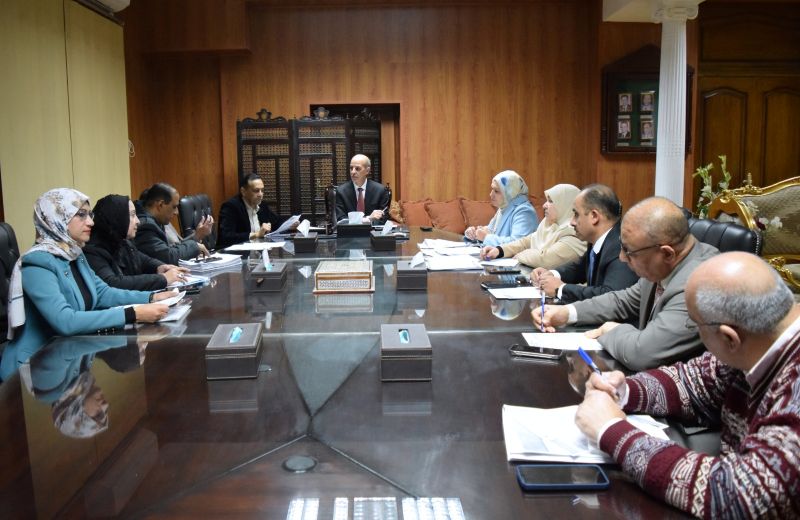
The President of Beni Suef University chairs the meeting of the Higher Committee for Languages ??and New Programs and reviews the administration's semi-annual report.
20 Jan 2026
Media Center
Dr. Tarek Ali, Acting President of Beni Suef University, chaired the meeting of the Higher Committee for Languages ??and New Programs, in the presence of Dr. Hamada Mohamed, Vice President of the University for Education and Student Affairs, Dr. Shaaban Mubarak, Financial Advisor, Dr. Amira Hammam, General Coordinator of Departments and Programs, and members of the Board of Directors.
The meeting discussed a number of topics related to student affairs and postgraduate studies in various programs. The university president also reviewed the semi-annual report of the Central Administration for Languages ??and New Programs, which included several topics, including the development and introduction of academic programs to keep pace with the requirements of the labor market. Approval was granted to include new programs with distinguished and modern specializations within the new departments and programs at the university in the postgraduate stage, including the Integrated Management of Environment and Water - Professional Master's program at the College of Graduate Studies for Advanced Sciences, the Professional Diploma and Professional Master's program at the College of Navigation Sciences and Space Technology, and the professional diploma and master's programs at the postgraduate stage with a credit-hour system at the College of Veterinary Medicine.
A qualitative leap was also achieved in increasing the number of students admitted to the various departments and programs for the academic year 2025/2026, which reached 2892 male and female students in various programs and departments.
The report included the university's participation in promoting and marketing its programs through the ninth annual Higher Education Fair, organized by Akhbar Al-Youm Foundation. This fair, the largest gathering of public, private, and national universities, higher institutes, and academies, including technological universities, provided the university with an excellent opportunity to announce its new departments and programs and attract a larger number of students. Additionally, the university held an orientation day for its programs and language departments for the 2025-2026 academic year, highlighting the advantages of enrolling in these programs and their relevance to the job market.
The Central Administration of Divisions, in cooperation with the Software Unit, also organized a workshop on the SPIS electronic system for divisions and distinguished programs at the university to develop the skills of program coordinators and directors of student affairs and postgraduate studies in colleges that include distinguished programs, to facilitate their dealings with the new program for departments and programs, and to achieve maximum benefit from the program’s features.
A specialized training workshop was also organized on the operational procedures of the control rooms using the SPIS system for departments and programs, with the aim of enhancing the efficiency of work teams and improving performance. The workshop was held in coordination with the university's software unit, under the supervision of Dr. Mohamed Qaid, Dean of the Faculty of Computers and Artificial Intelligence and Director of University Projects. The training was conducted by Engineer Tarek Khalil, who provided a detailed explanation of the tasks supported by the system and the mechanisms for managing the control rooms digitally, ensuring accuracy and speed of completion. This workshop is part of the university's efforts to support digital transformation and enhance employee efficiency, which will positively impact the quality of services provided to students and academic programs.
As part of the ongoing development of the SPIS system, the digital reporting package for the credit hour system has been updated immediately and accurately to include the extraction of academic status and financial positions data for students of classes and programs. This update aims to enhance institutional transparency and provide an integrated database that ensures rapid decision-making and supports accurate monitoring of the student's academic and financial progress.
The report also included a number of proposals to enhance the efficiency and effectiveness of the SPIS electronic system through a matrix of technical requirements and operational needs for the SPIS system for departments and programs, by working on developing the student registration and academic cases system, the control and results system, the statistical reports system, the technical support and crisis management system, and the academic regulations system.